When Would Iron Be The Right Choice for a Fencing Project
December 14, 2020
Tl;dr:
No.
We get questions like that very often.
Is iron fence ever an answer to home security?
The brief answer (with some qualifications): No.
What qualifications? We are talking about iron fencing for a residential or commercial setting where there is a requirement for the fencing to be aesthetically pleasing.
So, in this article, we are not talking about chain-link fences or about barbed wire fences. I have not researched with regard to aluminum or steel being used for these types of fences, to determine their relative value.
Mulholland Fence and Gate Requirement: Fencing Must be Beautiful!
At Mulholland, we deal only with residential, industrial, and commercial fencing that needs to be aesthetically pleasing. We’ve never seen a chain-link fence or a barbed-wire fence that really looked beautiful. And beauty is a requirement for all the work that we do. Not to say that chain-link and barbed wire don't have their applications, they do! But it is not the work we specialize in.
What is most important about gates and fences?
The most important ways to think about fences, gates, and railing are their strength, function, durability, style, and installation requirements. Over time, the cost of maintenance is also a factor.
Finally, how often will you need to replace a steel fence or gate?
Is Iron Fencing Ever the Best Bet for Strength?
Yes, and No. Yes, but only under the most extreme circumstances. Think of a foreign embassy under attack by tanks.
It’s imaginable that, if you were a drug czar or doing something criminal yet lucrative, that you might need one of the most strong iron alloy fences made. The highest strength of any iron alloy is stronger than the strongest aluminum alloy. And that’s very strong.
So, iron (actually steel, as will be discussed later) could conceivably better choice if you are talking about needing an over-the-top James Bond-type defense. In those circumstances, if money is tight it might be cheaper to hire a dozen black belt karate guys and give them machine guns. Super-duper fencing like that might cost more than what you are guarding.
The answer is “no” when comparing conventional iron with conventional aluminum. Aluminum is equal in strength and can be stronger. Also, our commercial and industrial “Ultra” lines can be built in a fashion that they are nearly impervious to even the most forceful attacks.
Is Iron Fencing Ever the Best Bet Functionally?
No. There aren’t any functions that an iron fence or gate can do better than another material. They don’t swing or slide better or more easily. Perhaps they are less efficient than wood, aluminum, or vinyl in that they weigh more and need greater power to make them move and stop.
Is Iron Fencing Ever the Best Bet for Durability?
Never. Iron rusts unless galvanized (coated with zinc). This is an expensive process, and a galvanized surface can weaken and be broken and leave the underlying steep open to rusting. Rusting weakens metal, eventually to the point of failure.
Is Iron Fencing Ever the Best Bet for Style?
No, with the most recent technologies, we can copy all styles ordinarily associated with iron.
Not only can we copy styles ordinarily associated with none, we can make aluminum fencing that looks just like wood, but with none of wood’s drawbacks.
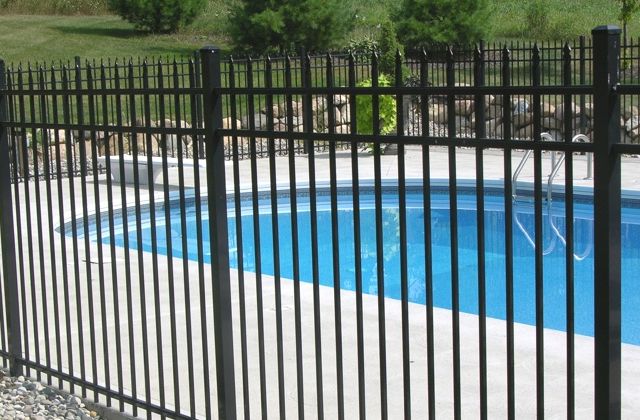
You will only see iron fencing painted black. The reason for this is that, eventually, water finds a way beneath painted steel. It then rusts, and this sometimes becomes weaker and weaker behind the surface paint. Often the paint will break open a bit and the rust will flow from beneath the paint to over it.
Black paint is the best paint to hide surface rust.
As an alternative, aluminum fencing is finished with powder-coating. This environmentally friendly process involves letting a chemical powder finish bake over the surface of our fencing under very high heat. This finish prevents rust and provides you with a wide variety of colors. It's a much more permanent finish.
This is an “extra” about aluminum fencing that makes them even more adjustable to just the style that you want.
Is Iron Fencing Ever the Best Bet for Installation?
Never. Iron is much heavier than aluminum, and this makes it much more difficult to install. Heavier loads also tire installation crews more quickly and increase the opportunities for injury during the installation.
The increased weight of the iron also means that they will need to be adjusted and put in alignment more often.
Is Iron Fencing Ever the Best Bet For Maintenance?
Not at all. Never! Intrinsic to steel is oxidation. The only way around it is the ultra-expensive and heavy stainless steel. All iron is heavy, and that means more frequent adjustment. No matter how well you paint it, and no matter the quality of the finish, water will one day find its way to the fence surface.
And then you will have problems.
How Long till Iron Needs Replacement?
If well-maintained and periodically painted. 15 years. Greater to the degree that there is a humid environment, e.g. the coast.
If you compare this to aluminum, we have seen responsibly maintained aluminum protect homes for three generations and more.
What every person shopping for fences should know about iron and steel.
Probably 99% of all metal fencing that is available today is made from either steel or aluminum. Making fencing out of other materials can be done but is not at all practical.
Prior to the late 1800s steel was only very rarely used as it was very difficult to process. Aluminum had not yet been used as a serious building material as well.
The whole world of metal gates and fencing was iron.
Steel came after Iron "faded away".
Manufacturers began gradually to stop using actual iron to make construction materials over a hundred years ago. There were a few holdouts, but the last furnace that produced iron closed down in the 1970s. From the 1800s on, the use of iron as a construction material gave way to steel.
“Because mild steel is cheaper and easier to mass-produce, the raw material wrought iron gradually disappeared, until the last ironworks ceased production in the 1970s. Wrought iron is no longer produced on a commercial scale but is still made for replication, restoration, and conservation of historical ironwork.The Complete History of Wrought Iron - www.timelesswroughtiron.com
(Note that wrought iron was the premier building material until steel replaced it. And this was not only for fences, gates, and rail, but for bridges, towers, and the high-rise buildings that architects weren’t able to build with iron. Steel was the new “King” of building materials.)
No one seems to know why people continue to call steel fence, iron fence. But they do!
Guess number one: steel is an alloy of iron. So, it still is iron and so there’s not really any rule broken in calling it so.
Guess number two: marketing was not much of a thing when they introduced steel into the world. There was never a competition between iron and steel in fence making. Fence makers welcomed the evolution in metal fencing; there wasn’t a protest from iron fence makers about it. It wasn’t necessary to differentiate it from the end-user as well. Why bother changing the name?
As italicized in the preceding citation. There are people who still use iron, real iron, and not a steel alloy, in “replication, restoration, and conservation of historical ironwork.”
In general, when people are writing about steel fences with the “wrought iron look” they will refer to it as iron fencing. When discussing steel fences with a more modern appearance, they will more often call it steel fencing.
I have also noticed that chain-link fence material is always referred to as steel, and never as iron.
Steel vs. Aluminum. In conclusion.
There isn’t a single real benefit to having a steel fence over an aluminum fence.
 Get Offer60%OffLimited Offer onLuxury FencingFactory Clear-OutUp to 60% Off Fencing